
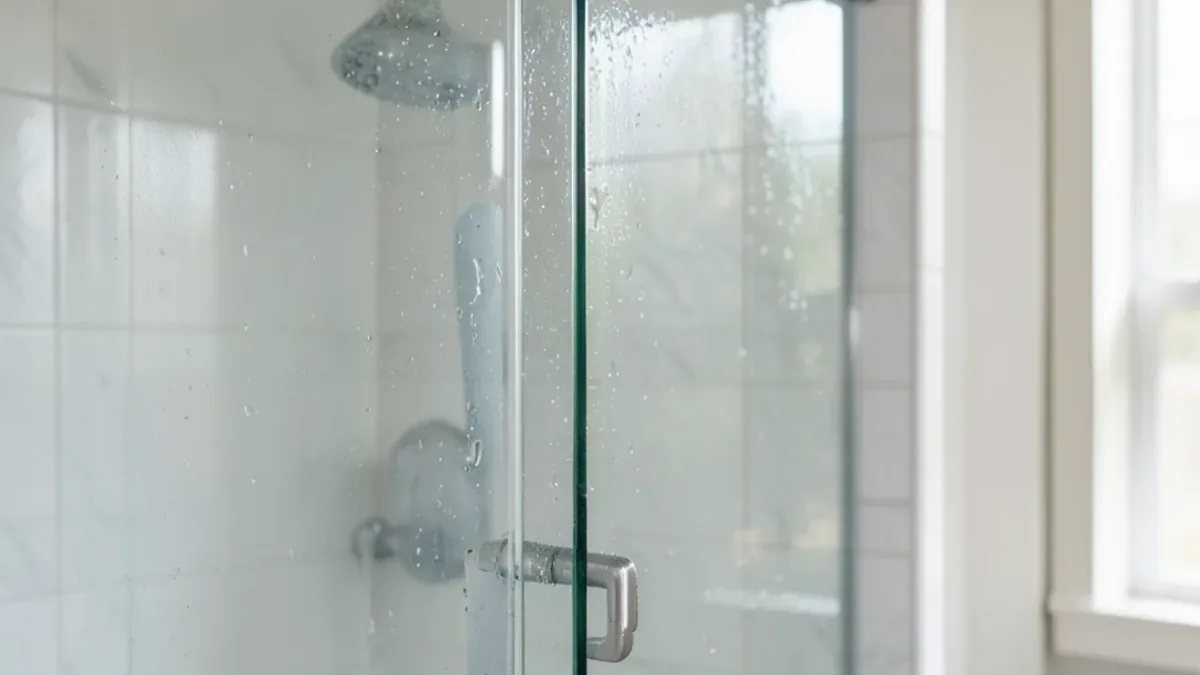
Shower glass hard water spots form when droplets evaporate and leave dissolved minerals behind, mostly calcium and magnesium. North Texas tap water carries enough of both that clear glass can look hazy within weeks. The right glass, a coating, a working fan and a 30-second squeegee habit keep most showers clear.
Below: why the spots form, how to read your own water report, what to decide during a remodel, and how to treat glass that is already clouded.
Why North Texas Showers Spot Up So Fast
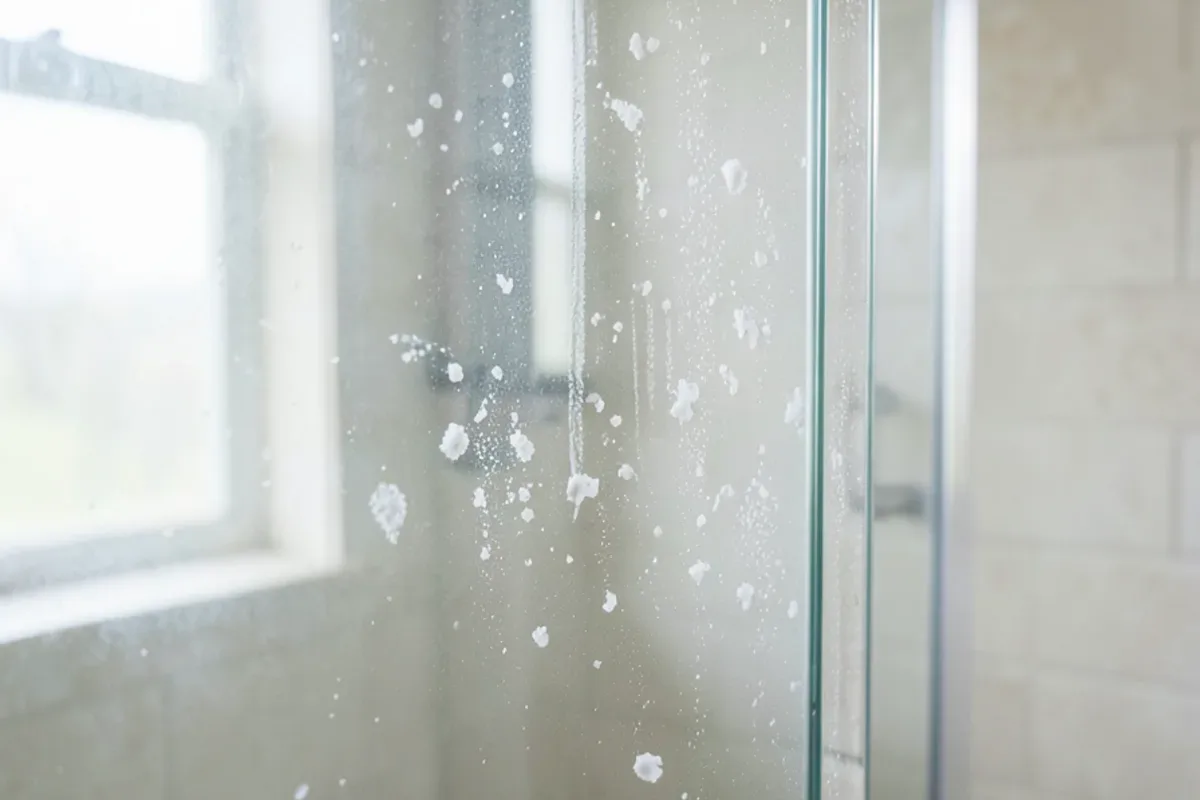
The white film on glass is mineral residue. According to the U.S. Geological Survey, water hardness comes mainly from dissolved calcium and magnesium, which form scale when water evaporates. Each droplet left on the glass dries into a tiny ring of that scale.
Soap adds to it. Hard water reacts with many soaps to form a residue that sticks to glass and grout. Hot showers and a closed, humid bathroom speed up both effects, because more water sits on the glass for longer.
Planning a Bathroom Remodeling Project?
Six Design Group designs and builds kitchens, baths and floors from Lake Highlands. Call to talk through your home and get a written scope.
- 34 Google reviews
- Design and build under one team
- Based in Lake Highlands, Dallas
- Mon–Fri 9 am–5 pm
How Hard Is the Water in Dallas and Plano?
Hardness varies by supplier and season, so check your own report instead of relying on a general number. Homes in Dallas are served by Dallas Water Utilities, which draws from several regional lakes. Much of Plano is served through the North Texas Municipal Water District. Both publish annual water quality reports that list hardness and mineral content.
Whatever your number, the pattern is the same across the area: clear glass in daily use will show spots unless water is removed or repelled before it dries.
How to read the hardness line in your water report
Utility reports list hardness in different units, so it helps to translate before comparing. The USGS sorts water into four general classes by calcium carbonate content:
| USGS class | Milligrams per liter (as calcium carbonate) | Roughly in grains per gallon | What you see on glass |
|---|---|---|---|
| Soft | 0 to 60 | Under about 3.5 | Faint marks, easy to wipe |
| Moderately hard | 61 to 120 | About 3.5 to 7 | Visible spots within days |
| Hard | 121 to 180 | About 7 to 10.5 | Haze that builds without a routine |
| Very hard | More than 180 | Over about 10.5 | Scale that needs a dissolving cleaner |
To use it, follow three steps:
- Find the "total hardness" line in your utility's annual water quality report. Some reports list calcium and magnesium separately instead.
- If the figure is in milligrams per liter, divide by 17.1 to get grains per gallon, the unit most softener makers use.
- Match the number to the table, then decide whether habits and a coating are enough or whether softening is worth pricing.
We do not publish a single hardness figure for Dallas or Plano because the reports change year to year and by source lake. Your own report is the number that counts.
Glass Choices That Make a Difference in a Remodel
If you are planning a new shower, some decisions made now will affect how much cleaning the glass needs for years:
- Factory-applied coating. Many glass fabricators offer a protective coating that makes water bead and run off. It does not stop spots entirely, but deposits wipe away more easily.
- Fixed panel versus door. A fixed panel has fewer edges and hardware where scale builds up. A door adds hinges and seals to clean.
- Clear, low-iron or textured. Low-iron glass looks less green at the edges but shows spots just as clearly. Textured or frosted glass hides spots better, at the cost of an open look.
- Showerhead placement. Aim the main head away from the glass, and place a handheld where it will not spray the door every day.
- Glass height and transom. A small gap or operable transom at the top lets steam escape so the glass dries faster.
Daily and Weekly Habits That Keep Glass Clear
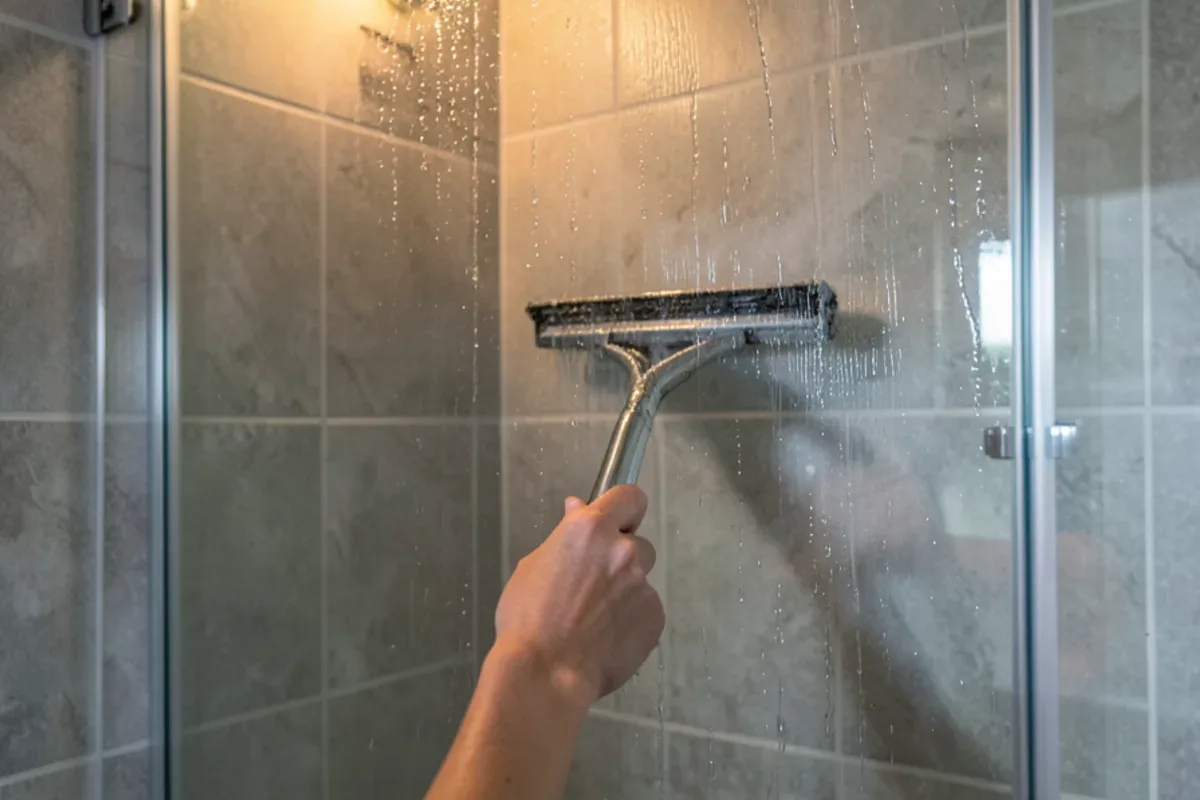
The single most effective step is a squeegee after every shower. Removing the water before it dries means there is nothing left to form a spot. It takes about half a minute.
Beyond that, run the exhaust fan during the shower and for a while afterward, wipe the glass weekly with a cleaner safe for any coating, and avoid abrasive pads that scratch glass and strip coatings. If your shower has marble or travertine, keep acidic cleaners like vinegar off the stone.
Fixtures need the same attention. Mineral buildup clogs showerhead nozzles, which changes the spray pattern and can send water sideways onto the glass. Soaking or wiping the nozzles every few months keeps the spray aimed where it was designed to go. Sealing cement-based grout on the schedule its maker recommends also keeps residue from settling into the joints next to the glass.
Fixing Glass That Is Already Spotted
Light spotting usually comes off with a mineral-dissolving cleaner made for glass and a soft cloth. Heavier buildup may take a few rounds. Once glass is clean, a coating applied by a glass professional can slow new deposits.
If the glass has been etched, the surface itself is damaged and cleaning will not fully restore it. At that point, replacing the panel or door, ideally with a coated product and a better ventilation setup, is often the practical fix during a shower remodel.
What Our Project Leads Plan Into Every Glass Shower
Our project leads treat ventilation as part of the glass decision. A fan sized for the room and ducted outside, not into the attic, helps the whole shower dry faster, which protects glass, grout and paint. We also ask how you shower: a rainhead in the center of the ceiling wets the glass far more than a wall head aimed at the back wall.
Some homeowners choose a whole-house water softener alongside a remodel. That is plumbing work for a licensed plumber, and it changes water for the whole house, so it is worth comparing on its own merits, not only for the glass.
Softener, conditioner or neither?
The three options behave differently on glass, and the difference is worth knowing before you buy:
- Salt-based softener. Exchanges calcium and magnesium for sodium or potassium, so far less scale forms. It needs a drain for regeneration, regular salt and a loop in the supply line, which is easier to add when walls or the garage are already open.
- Salt-free conditioner. Changes how minerals form scale inside pipes and heaters, but it leaves the minerals in the water. Droplets that dry on glass still leave marks, so it does little for spots.
- No treatment. Workable for most showers with coated glass, a fixed panel, a squeegee and a fan that actually runs. This is where we start the conversation, because it costs nothing to maintain.
Fixture finish matters too. Matte black and brushed finishes show white mineral rings more than polished chrome does, so in a house with hard water, pick the finish knowing it will show what the water leaves behind.
The honest summary from our project leads: no product makes clear glass maintenance-free in North Texas. Design choices shorten the routine; they do not remove it.
Decisions to Make Before the Glass Is Ordered
Glass is measured after tile, but the choices that set how it behaves are made much earlier. Settle these during design:
- Coating: factory-applied, or none and a retail product later.
- Configuration: fixed panel, hinged door or slider, and how much open gap is left for airflow.
- Head placement: which wall the main head faces and where the handheld parks.
- Fan: its size, a timer or humidity switch, and a duct that ends outdoors.
- Stone or porcelain: if marble or travertine is on the walls, which cleaners are allowed, because the glass cleaner must not etch the stone.
Planning a Shower You Can Keep Clear
The easiest glass to keep clear is the one designed for it from the start: coated, sized to limit splash, with good airflow and a head that points away from it. If your current shower fights you every week, our bathroom remodeling team can walk through glass, fixture and fan options with you. Schedule a consultation and we will look at how your shower is used today.
Quick Answers on Shower Glass Hard Water Spots
Why does my shower glass turn cloudy even after cleaning?
Does a water softener stop shower glass spots?
Will a salt-free water conditioner keep shower glass clear?
Are vinegar cleaners safe for every shower?
Sources

Written by the Six Design Group team
Design-build remodelers based in Lake Highlands, Dallas. We plan and build kitchens, bathrooms, floors and whole-home remodels across Dallas-Fort Worth.