
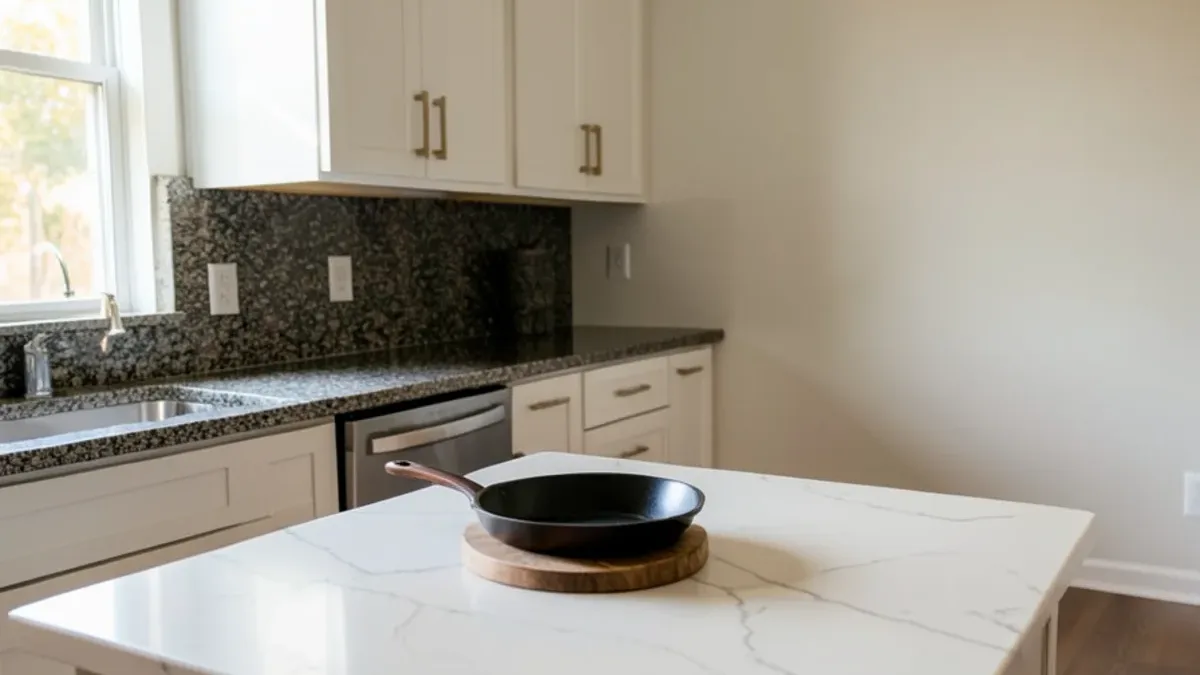
Quartz vs granite countertops is a trade between low maintenance and heat tolerance. Quartz is engineered from ground quartz and resin: it never needs sealing and resists stains, but it can scorch under a hot pan. Granite is natural stone: it shrugs off heat and sun, but some slabs need periodic sealing.
What Is the Difference Between Quartz and Granite?
Quartz countertops are manufactured; granite countertops are quarried. That single fact explains most of the differences in care, look and performance.
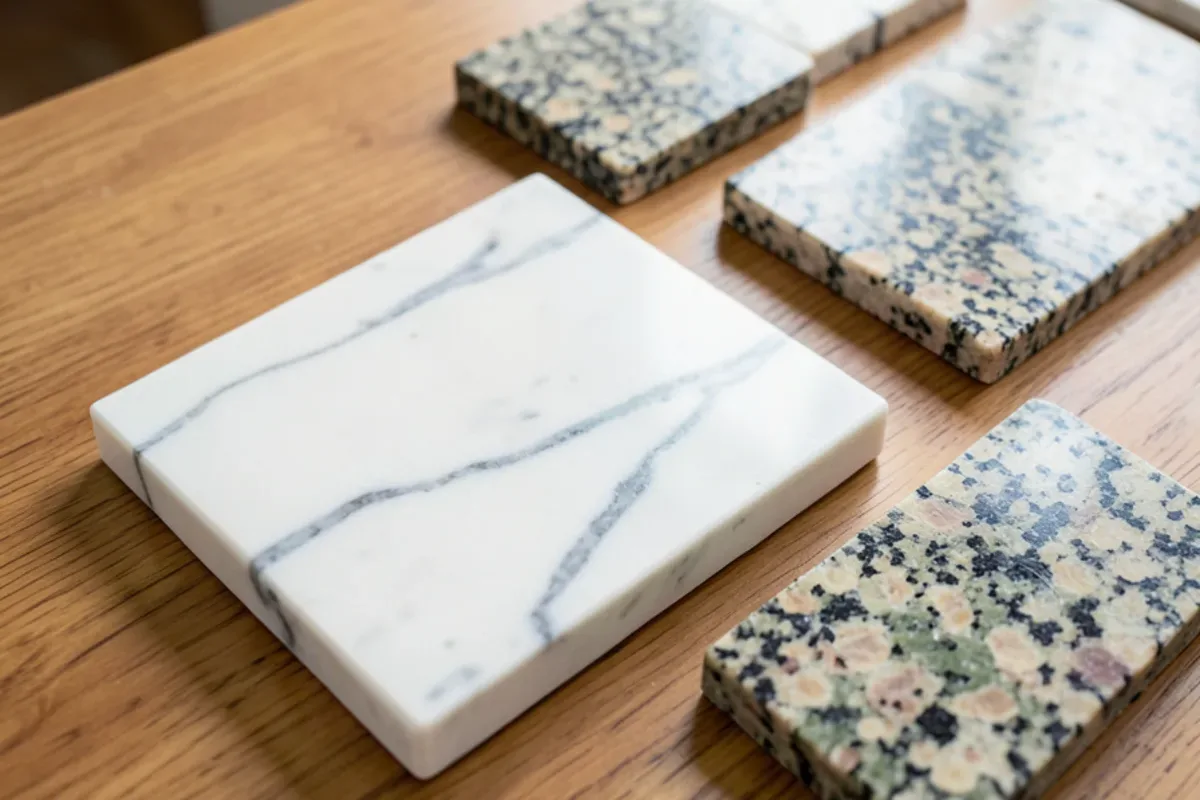
Quartz slabs are made from crushed quartz, typically around nine-tenths of the slab by weight, mixed with polymer resins and pigments, then pressed and cured. The result is non-porous and uniform. Granite is an igneous rock made largely of feldspar and quartz, cut from a quarry block into slabs. No two granite slabs match, and each has its own porosity.
"Granite" in a showroom is also a trade name, not only a geology term. Many dark stones sold as granite are technically gabbro or similar igneous rocks. They perform much like granite and often absorb less, but it is one more reason to judge the slab in front of you rather than the color name on the tag.
Many granite slabs are also resin-treated at the factory. Fine fissures are filled with clear resin and the face is polished over it, which makes a fragile-looking slab sound and tightens its surface. Ask whether a slab is resin-treated, because that changes how often it may need sealing.
Planning a Countertops Project?
Six Design Group designs and builds kitchens, baths and floors from Lake Highlands. Call to talk through your home and get a written scope.
- 34 Google reviews
- Design and build under one team
- Based in Lake Highlands, Dallas
- Mon–Fri 9 am–5 pm
Quartz vs Granite Countertops Compared Point by Point
The table below compares the two on what matters day to day.
| Factor | Quartz | Granite |
|---|---|---|
| Heat | Resin can scorch or crack; use trivets | Highly heat resistant |
| Stains | Non-porous, resists stains | Varies; sealed slabs resist most stains |
| Sealing | Never needed | Periodically, depending on the slab |
| Scratches | Very scratch resistant | Very scratch resistant |
| Direct sun | Some products fade or yellow | Unaffected |
| Look | Consistent color and pattern | One-of-a-kind natural variation |
| Seams | Easier to match pattern across seams | Depends on the slab's movement |
Both are hard enough that a kitchen knife will not scratch them. Granite's main minerals rate around 6 to 7 on the Mohs hardness scale, and quartz itself rates 7.
Which Holds Up Better in a Texas Kitchen?
For heat and sunlight, granite. For stains and zero maintenance, quartz. Texas kitchens tend to test both.
The physics behind the heat difference is simple. Granite formed from molten rock and holds its color and strength at temperatures a stovetop never reaches. Quartz is roughly nine parts stone to one part polymer resin, and that resin softens and discolors at far lower temperatures than the stone around it. A pan straight off a burner can leave a pale ring or a hairline crack, especially near a sink cutout where the slab is narrowest. Neither stone likes thermal shock: a frozen bag dropped on a hot spot, or boiling water poured onto a cold slab, stresses any seam.
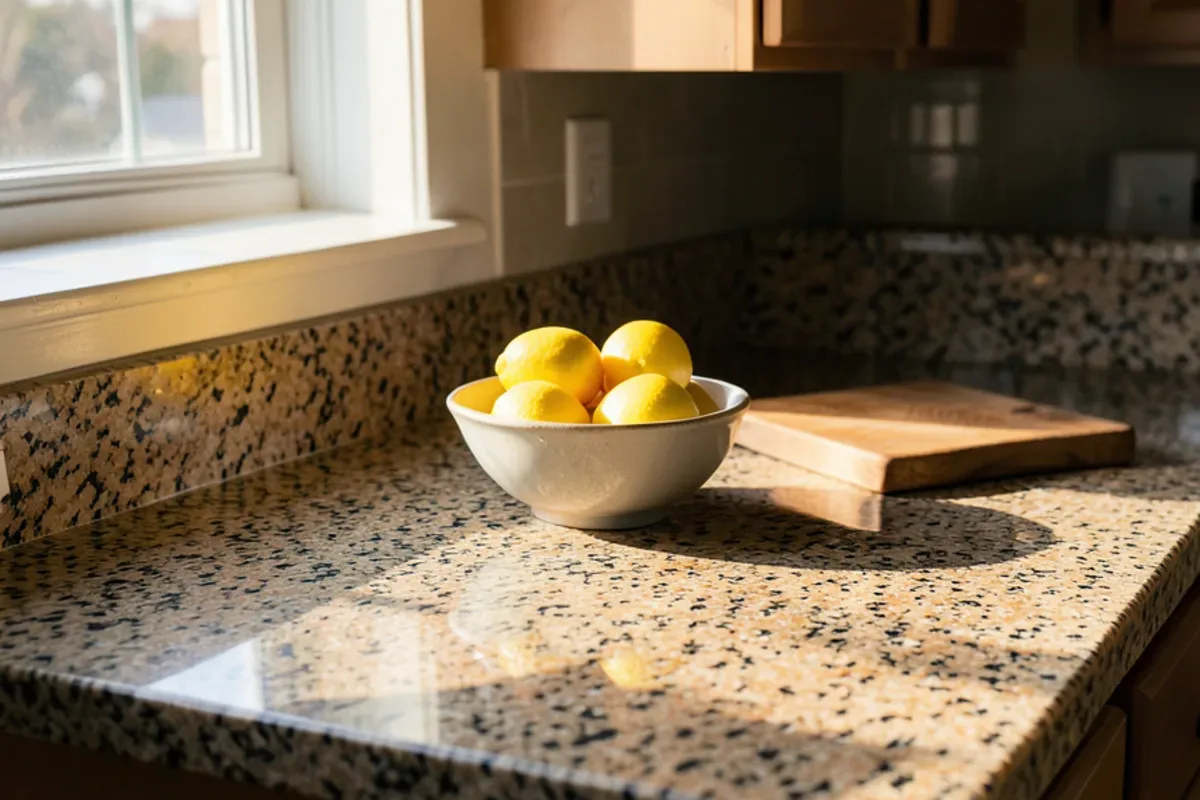
North Texas summers mean long, direct afternoon sun through west-facing windows. If one stretch of counter sits in that light for hours, granite will not change color, while some quartz products can. Cooking habits matter too: if hot cast iron goes straight from the stovetop to the counter, granite forgives that and quartz may not.
On the other hand, red wine, coffee, cooking oil and turmeric are hard on porous stone. Quartz handles all of them without sealer. Read more on our quartz countertops page or our granite countertops page.
How Do Quartz and Granite Compare on Price?
Their price ranges overlap heavily, so material choice alone does not decide the budget. Entry-level granite and entry-level quartz cost about the same; exotic granites and premium marble-look quartz both climb well above average.
For a national reference, Fixr (updated January 2026) puts a typical quartz countertop installation at $2,600 to $4,400, with a $3,500 national average, and quartz material alone at roughly $50 to $200 or more per square foot depending on grade. Those are national figures, not our prices. Edge profile, cutouts, seams, backsplash height and tear-out move the final number at least as much as the material does.
Cost Drivers Beyond the Slab
Whichever stone you pick, these line items shape the quote:
- Square footage and slab count. A long island may need a jumbo slab or a seam, and leftover pieces from a second slab are still paid for.
- Edge profile. A simple eased edge costs less than an ogee or a mitered thick edge.
- Cutouts. Undermount sinks, cooktops and faucet holes each add fabrication time.
- Backsplash. A 4-inch stone splash costs less than full-height stone behind the range.
- Tear-out. Removing old tile counters takes longer than lifting laminate.
What to Check at the Slab Yard
Picking stone in person avoids most surprises. Take this list with you:
- See the full slab, not a sample, and photograph it with something for scale.
- Ask the slab size and compare it with your longest run and your island, so you know where seams must fall.
- Look along the surface in raking light for pits, filled fissures and dull patches.
- Ask whether granite is resin-treated and whether it has been sealed.
- Drip water on a granite offcut; if it darkens within a few minutes, plan on regular sealing.
- For quartz, check the same batch number on every slab you buy, since color can shift between production runs.
What Our Project Leads See in Dallas, Plano and Garland Kitchens
Our project leads find that the existing kitchen often points to the right answer. In Garland, many 1960s to 1980s brick ranch homes still have original tile counters on oak cabinets. Owners keeping those cabinets often choose granite or a warm-toned quartz that suits wood. In east and central Plano, 1970s to 1990s kitchens with tile counters frequently move to white or marble-look quartz for an updated, lighter look.
Across Dallas, a few habits help any choice:
- View the actual granite slab before it is cut, so the veining lands where you want it.
- Ask where seams will fall, especially on an L-shaped run or a long island.
- Confirm that cabinets are level before templating, since stone will not bend to fit. On Blackland Prairie clay, house foundations move with wet and dry seasons, and a long stone run over an unlevel base is the first place a seam opens.
One more point that rarely comes up in showrooms: silica dust. OSHA and NIOSH updated their hazard alert on countertop fabrication, reported by the American Industrial Hygiene Association in March 2026, noting that the highest silica levels are found in certain engineered stone and quartzite, while granite contains up to 50 percent silica. The risk is to the people cutting and grinding the stone, not to you using a finished counter. It is still fair to ask your fabricator to make cutouts in the shop and to cut wet with dust control if anything must be trimmed in your house.
So, Quartz or Granite?
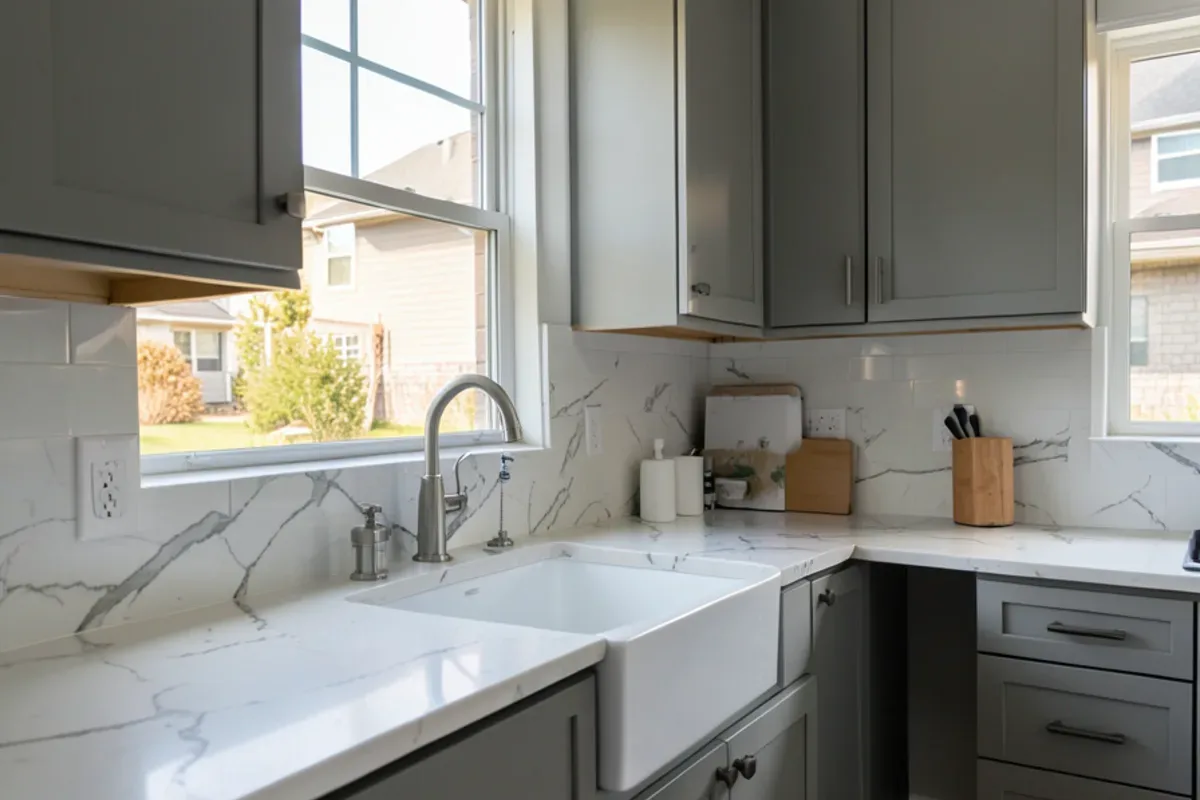
Choose quartz if you want a uniform look and no sealing, and you are happy to use trivets. Choose granite if you cook hot and fast, have counters in strong sun, or want a slab nobody else has. Both are excellent kitchen surfaces.
Our countertops page covers selection, templating and installation for every stone we work with. Schedule a consultation and ask to see samples of both in your own kitchen light.
Quick Answers on Quartz Vs Granite Countertops
Can I set a hot pan directly on quartz?
Does granite need sealing every year?
Is quartz or granite better near a sunny window?
Is quartz or granite easier to repair if the edge chips?
Sources

Written by the Six Design Group team
Design-build remodelers based in Lake Highlands, Dallas. We plan and build kitchens, bathrooms, floors and whole-home remodels across Dallas-Fort Worth.